Let’s look at some of the distinctive features of the Theravada, Chinese and Tibetan forms of Buddhism as representative of the major systems extant today.
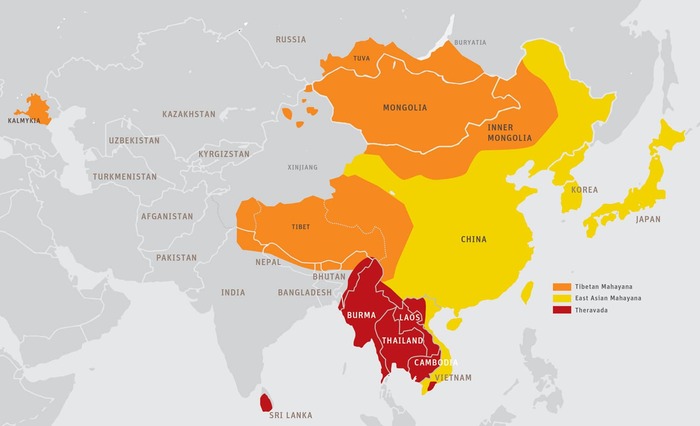
Theravada
Theravada, practiced in Southeast Asia, emphasizes the practice of mindfulness meditation. This is done by focusing on the breath and the sensations in the body while sitting, and on the movements and intentions to move while walking extremely slowly. With mindfulness of the arising and falling of each moment, one gains an experiential realization of impermanence. When this understanding is applied to analyzing all one’s experience, one realizes that there is no permanent, unchanging self that exists independently of everything and everyone else. All is momentary changes. In this way, one gains an understanding of reality that will liberate oneself from self-centered concern and the unhappiness it brings.
Theravada also teaches meditations on immeasurable love, compassion, equanimity and joy, but only in the last decades has it had a movement of what is called “Engaged Buddhism,” starting in Thailand, for engaging Buddhists in programs of social and environmental help.
Theravada monks study and chant the Buddhist scriptures and perform ritual ceremonies for the lay public. The monks go on daily rounds of silent begging for alms, and the householders practice generosity by offering them food.
East Asian Mahayana
The East Asian Mahayana traditions deriving from China have two main aspects: Pure Land, and what in Japan is known as Zen.
- The Pure Land tradition emphasizes recitation of the name of Amitabha, the Buddha of Infinite Light, as a method for going to his Pure Land of Happiness, a type of paradise in which everything is conducive for becoming a Buddha.
- Zen stresses strict meditation in which one quiets the mind of all conceptual thought so that the pure nature of the mind as compassionate and endowed with wisdom will shine forth.
Monks and nuns in both traditions chant scriptural texts and, in keeping with Confucian culture, perform ceremonies especially for the deceased ancestors of the lay community.
Tibetan Mahayana
The Tibetan form of Mahayana Buddhism found throughout Central Asia preserves the full historical development of Indian Buddhism, particularly the traditions of the great monastic universities such as Nalanda. Thus, it emphasizes study, particularly about the nature of the mind, the emotions and reality, through the medium of logic and debate, carried out in conjunction with intense meditation on these topics.
This approach is combined, in Tibet, with the Indian Buddhist tradition of tantra practice, in which one uses the powers of the imagination and works with the subtle energies of the body to transform oneself into a Buddha. This is done by concentrating on voidness (emptiness) and compassion, and within that context, imagining oneself to have become a specific Buddha-form. Although such forms are sometimes called “meditation deities,” they are not the equivalent of God in meaning or function, and Buddhism is not in any way a polytheistic religion. Each Buddha-form is a symbolic representation of one aspect of a Buddha’s enlightenment, such as wisdom or compassion. Visualizing oneself in such a form and reciting the sacred syllables (mantras) associated with it helps one to overcome one’s deluded, negative self-image and to develop the qualities embodied by that figure. Such practices are very advanced and require close supervision by a fully qualified teacher.
Tibetan Buddhism also has a great deal of chanting and ritual, often designed to eliminate negative forces and interference visualized in the form of demons. While performing such rituals, one imagines oneself in an extremely forceful form as a meditational aid for gaining the energy and confidence to overcome difficulties. There is also great emphasis on meditational techniques for cultivating love and compassion, also involving the use of visualization.
Summary
Whether one looks at the mindfulness practices of Theravada, the chanting of Amitabha Buddha’s name in China, or debate and visualization practices in Tibet, all forms of Buddhism fit within the same context. They each provide effective methods for overcoming suffering and realizing one’s potentials, not only for one’s own sake, but also for being able to benefit others as much as is possible.