Often the five aggregate factors of experience (phung-po lnga, Skt. panca skandha; five aggregates), are mentioned together with the twelve cognitive stimulators (skye-mched bcu-gnyis, Skt. dvadasha ayatana) and the eighteen cognitive sources (khams bcu-brgyad, Skt. ashtadasha dhatu). In the study of abhidharma, special topics of knowledge, one explores the logical pervasions between these three sets of phenomena.
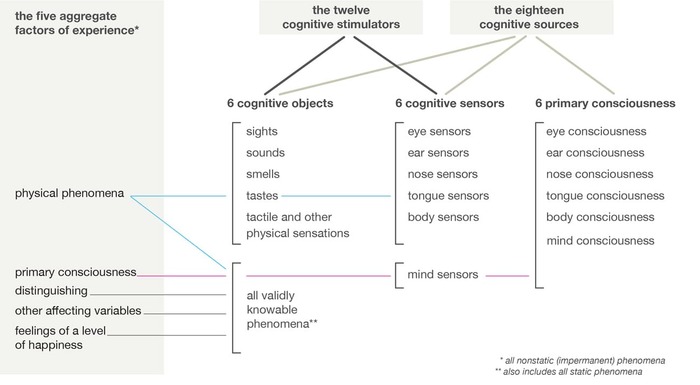
The Five Aggregate Factors of Experience
The five aggregate factors of experience encompass all nonstatic (impermanent) phenomena:
- The aggregate of forms of physical phenomena (gzugs-kyi phung-po; aggregate of forms) – all forms of physical phenomena (gzugs)
- The aggregate of primary consciousness (rnam-shes-kyi phung-po; aggregate of consciousness) – within ways of being aware of something (shes-pa), the six types of primary consciousness (rnam-shes)
- The aggregate of feelings of a level of happiness (tshor-ba’i phung-po) – among the mental factors (sems-byung, subsidiary awareness), feeling a level of happiness (tshor-ba)
- The aggregate of distinguishing (’du-shes-kyi phung-po) – among the mental factors, distinguishing (‘du-shes)
- The aggregate of other affecting variables (‘du-byed-kyi phung-po, Skt. samskara skandha) – all other mental factors, plus the noncongruent affecting variables (ldan-min ’du-byed), such as karmic tendencies (sa-bon; karmic seeds) and the conventional “me.”
Static (permanent) phenomena are not included among the five aggregate factors of experience.
[See: Basic Scheme of the Five Aggregates, The Aggregate of Forms of Physical Phenomena, Primary Minds and the 51 Mental Factors, and Congruent and Noncongruent Affecting Variables]
The Twelve Cognitive Stimulators
The twelve cognitive stimulators include all validly knowable phenomena, both nonstatic and static. They include the six types of cognitive objects (yul) and the six types of cognitive sensors (dbang-po, Skt. indriya).
The six cognitive stimulators that are types of cognitive objects are:
- The cognitive stimulators that are sights (gzugs-kyi skye-mched)
- The cognitive stimulators that are sounds (sgra’i skye-mched)
- The cognitive stimulators that are smells (dri’i skye-mched)
- The cognitive stimulators that are tastes (ro’i skye-mched)
- The cognitive stimulators that are tactile and other physical sensations (reg-bya’i skye-mched)
- The cognitive stimulators that are all validly knowable phenomena (chos-kyi skye-mched).
The first five of these items are validly known by both their corresponding sensory consciousness, for instance the cognitive stimulators that are sights by eye consciousness, as well as by mental consciousness. There is some debate, however, concerning whether cognitive stimulators that are sights are also validly cognizable by body consciousness, since sights are defined as colors and shapes. A spherical shape, for example, can not only be seen, but also validly known by holding a ball in one’s hand.
The cognitive stimulators that are all validly knowable phenomena can be validly cognized by mental consciousness. These phenomena include the three types of nonstatic phenomena – forms of physical phenomena, ways of being aware of something, and noncongruent affecting variables. They also include all static phenomena.
The six cognitive stimulators that are cognitive sensors are:
- The cognitive stimulators that are the eye sensors (mig-gi dbang-po’i skye-mched), namely the photosensitive cells of the eyes
- The cognitive stimulators that are the ear sensors (rna’i dbang-po’i skye-mched), namely the sound-sensitive cells of the ears
- The cognitive stimulators that are the nose sensors (sna’i dbang-po’i skye-mched), namely the smell-sensitive cells of the nose
- The cognitive stimulators that are the tongue sensors (lce’i dbang-po’i skye-mched), namely the taste-sensitive cells of the tongue
- The cognitive stimulators that are the body sensors (lus-kyi dbang-po’i skye-mched), namely the cells of the body that are sensitive to physical sensations
- The cognitive stimulators that are the mind sensors (yid-kyi dbang-po’i skye-mched) namely the primary consciousness in the moment immediately preceding a cognition.
The first five of these items are forms of physical phenomena. The last item includes all six types of primary consciousness.
As for the pervasions between the sets of the five aggregate factors and the twelve cognitive stimulators:
- Part of the cognitive stimulators that are all validly knowable phenomena, plus ten of the other cognitive stimulators, excluding the cognitive stimulators that are the mind sensors, are included in the aggregate of forms of physical phenomena.
- The cognitive stimulators that are the mind sensors, plus part of the cognitive stimulators that are all validly knowable phenomena, are included in the aggregate of primary consciousness.
- Part of the cognitive stimulators that are all validly knowable phenomena are included in the aggregate of feelings of a level of happiness and the aggregate of distinguishing.
- Part of the cognitive stimulators that are all validly knowable phenomena are included in the aggregate of other affecting variables.
- Part of the cognitive stimulators that are all validly knowable phenomena also include all static phenomena and these are not included in the five aggregate factors of experience.
Thus, the twelve cognitive stimulators include all five aggregate factors of experience, but the aggregate factors do not include all items within the twelve cognitive stimulators.
The Eighteen Cognitive Sources
The eighteen cognitive sources – literally, the eighteen constituent components of cognitions – also include all validly knowable phenomena. The eighteen add to the twelve cognitive stimulators the six types of primary consciousness.
The six cognitive sources that are types of cognitive objects are:
- The cognitive sources that are sights (gzugs-kyi khams)
- The cognitive sources that are sounds (sgra’i khams)
- The cognitive sources that are smells (dri’i khams)
- The cognitive sources that are tastes (ro’i khams)
- The cognitive sources that are tactile and other physical sensations (reg-bya’i khams)
- The cognitive sources that are all validly knowable phenomena (chos-kyi khams).
The six cognitive sources that are cognitive sensors are:
- The cognitive sources that are the eye sensors (mig-gi dbang-po’i khams), namely the photosensitive cells of the eyes
- The cognitive sources that are the ear sensors (rna’i dbang-po’i khams), namely the sound-sensitive cells of the ears
- The cognitive sources that are the nose sensors (sna’i dbang-po’i khams), namely the smell-sensitive cells of the nose
- The cognitive sources that are the tongue sensors (lce’i dbang-po’i khams), namely the taste-sensitive cells of the tongue
- The cognitive sources that are the body sensors (lus-kyi dbang-po’i khams), namely the cells of the body that are sensitive to physical sensations
- The cognitive sources that are the mind sensors (yid-kyi dbang-po’i khams) namely the primary consciousness in the moment immediately preceding a cognition.
The six cognitive sources that are kinds of primary consciousness are:
- The cognitive sources that are the eye consciousness (mig-gi rnam-shes-kyi khams)
- The cognitive sources that are the ear consciousness (rna’i rnam-shes-kyi khams)
- The cognitive sources that are the nose consciousness (sna’i rnam-shes-kyi khams)
- The cognitive sources that are the tongue consciousness (lce’i rnam-shes-kyi khams)
- The cognitive sources that are the body consciousness (lus-kyi rnam-shes-kyi khams)
- The cognitive sources that are the mind consciousness (yid-kyi rnam-shes-kyi khams).
As for the pervasions between the sets of the five aggregate factors and the eighteen cognitive sources:
- Part of the cognitive sources that are all validly knowable phenomena, plus the five cognitive sources that are the other cognitive objects, plus the five cognitive sources that are cognitive sensors, excluding the mind sensors, are included in the aggregate of forms of physical phenomena.
- Part of the cognitive sources that are all validly knowable phenomena, plus the cognitive sources that are the mind sensors, plus the six cognitive sources that are kinds of primary consciousness are in the aggregate of primary consciousness.
- Part of the cognitive sources that are all validly knowable phenomena are included in the aggregate of feelings of a level of happiness and the aggregate of distinguishing.
- Part of the cognitive stimulators that are all validly knowable phenomena are included in the aggregate of other affecting variables.
- Part of the cognitive sources that are all validly knowable phenomena also include all static phenomena and these are not included in the five aggregate factors of experience.