The Sautrantika, Chittamatra and Yogachara-Svatantrika Systems
Karmic Impulses and Karmic Actions
There is no common locus (gzhi-mthun) between a karmic impulse (las, Skt. karma,karmic urge) and a karmic action; there is nothing that is both. All karmic impulses are mental factors (sems-byung, subsidiary awareness) – namely, the mental factor of an urge (sems-pa). Some karmic impulses immediately precede a physical, verbal, or mental action, and draw us to engage in that act. Others accompany the action itself, as the urges that initiate, sustain, and eventually stop the action. Karma, however, is not the action itself.
An action as a whole is a noncongruent affecting variable (ldan-min ’du-byed), a nonstatic imputation that is neither a form of physical phenomenon nor a way of being aware of something and which shares five things in common with the primary consciousness it accompanies. As an imputation, an action is a nonstatic synthesis that includes physical and mental components as well as components that are neither of the two.
Karmic impulses as well as karmic actions may be constructive (dge-ba, virtuous), destructive (mi-dge-ba, nonvirtuous), or unspecified (lung-ma-bstan, neutral).
"Constructive," here, means tainted constructive karmic impulses. "Tainted" (zag-bcas) means that they are mixed with unawareness (ignorance) of how things exist and throw one into a future samsaric rebirth.
"Unspecified" means that Buddha did not specify them as either constructive or destructive. They take on the ethical status of what accompanies them. Here, unspecified means obstructive unspecified karmic impulses (bsgribs-pa’i lung-ma-bstan). These are karmic impulses that are accompanied by one of the five disturbing attitudes with an outlook on life (nyong-mongs lta-ba-can, five deluded outlooks), which themselves are obstructive unspecified phenomena, but by neither any of the five disturbing emotions that are without an outlook on life (lta-ba-min nyon-mongs), which themselves are destructive phenomena, nor any of the constructive emotions.
Two Phases of Karmic Force
Unlike karmic impulses and karmic actions, karmic force may only be tainted constructive or destructive. Thus there is positive karmic force (bsod-nams, merit) and negative karmic force (sdig-pa, sin).
Each of these two types of karmic force has two phases:
The first phase of karmic force is as a karmic action itself, whether it be a physical, verbal, or mental karmic action.
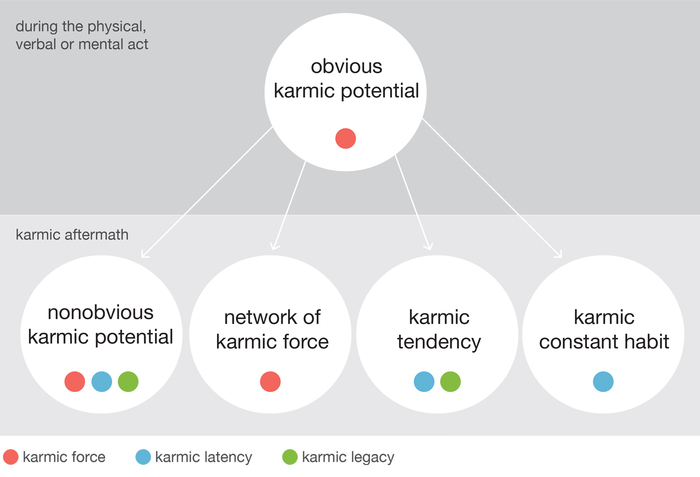
The second phase arises after the action ceases, when the karmic force as a karmic action undergoes a phase transition. It then becomes karmic force that has taken on the essential nature of a karmic tendency (sa-bon-gyi ngo-bor gyur-ba). This second phase of karmic force is both a karmic force and a karmic tendency (sa-bon, Skt. bīja). It is still either a positive or a negative karmic force, and thus still either a tainted constructive or a destructive phenomenon. This is because if something is a positive or a negative karmic force, it is pervasive that it is tainted constructive or destructive.
Both karmic force as a karmic action and karmic force that has taken on the essential nature of a karmic tendency are noncongruent affecting variables.
We must differentiate this karmic force that has taken on the essential nature of a karmic tendency from the second type of karmic aftermath – karmic tendencies that are neither a positive nor a negative karmic force and thus are obstructive unspecified phenomena. They are unspecified to be either constructive or destructive: they are ethically neutral phenomena that nevertheless obstruct liberation. Both types of karmic tendency, however, also are noncongruent affecting variables (ldan-min ’du-byed).
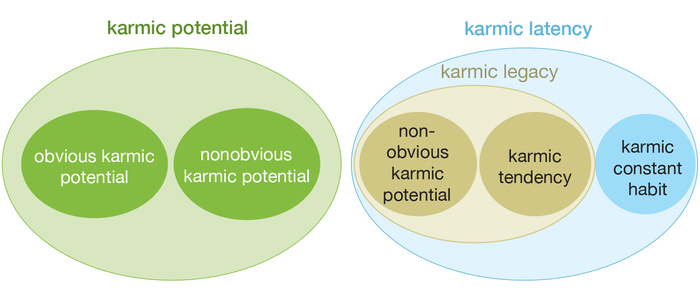
To make it easier to understand, let us call the karmic tendencies that are karmic forces karmic potentials – either positive or negative karmic potentials. Let us call the karmic tendencies that are not karmic forces simply karmic tendencies. As a general term for both types of karmic tendency, let us use the term karmic legacies.
Also, to avoid confusion, let us use the term obviouskarmic potential for karmic force as a karmic action and nonobvious karmic potential for karmic force as a karmic legacy. That is simply the action and not its legacy. Thus, the first phase of a karmic force is the obvious positive or negative karmic potential; the second phase is the nonobvious positive or negative karmic potential.
Two Types of Karmic Habit
There are also two types of karmic habit (bag-chags): karmic constant habits and karmic legacies, both of which are noncongruent affecting variables. The difference is that, unless we achieve a true stopping (’gog-bden, true cessation) of them, karmic constant habits give rise to their results continually, forever; while karmic legacies give rise to their results intermittently until they naturally end. Further, karmic constant habits are obstructive unspecified phenomena, while karmic legacies include both obstructive unspecified karmic tendencies and unobvious tainted constructive karmic potentials or destructive karmic potentials.
Here, "bagchag" (karmic habit) is a term used for both a general category (karmic habit) and a specific item in that category (karmic constant habit). As a general term for both types of karmic habit, let us use the term karmic latencies, to minimize confusion.
In summary, there are two types of karmic force: what we shall call an "obvious karmic potential" and a "nonobvious karmic potential." There are two types of karmic legacy: what we shall call a "nonobvious karmic potential" and a "karmic tendency." And there are two types of karmic latency: what we shall call a "karmic legacy" and a "karmic constant habit."
Other Applications of the Technical Terms
This terminology can also help us to make sense when the terms sabon (seed) and bagchag (habit) are used in conjunction with disturbing emotions and attitudes (nyon-mongs, afflictive emotions), grasping for true existence (bden-’dzin), and what we call in the West "memories." They all are latencies (bag-chag) and obstructive unspecified phenomena.
Disturbing emotions and attitudes have both kinds of latency: tendencies (sa-bon) that give rise to results intermittently and constant habits (bag-chag) that give rise to results constantly.
Grasping for true existence only has latencies (bag-chag), but they are only the type of latency that are constant habits, since the results they give rise to arise continuously.
Memories are only called latencies (bag-chag), but they are only the type of latency that are tendencies, since they give rise to results only intermittently.
Further Terms
The term network of positive force (bsod-nams-kyi tshogs, collection of merit) appears as a technical term only in reference to an enlightenment-building network of positive force, built up with bodhichitta and resulting in enlightenment. However, to make the explanation of the mechanism of karma easier to understand, I think we can also speak of a "samsara-building network of positive force." If we accept that convention, then we can also speak of a "samsara-building network of negative force" and, as a general term for both, we can speak of "networks of karmic force." A network of karmic force would cover both phases of karmic force: when the karmic force is obvious karmic potential and when it is nonobvious karmic potential.
I think "network" gives a clearer understanding than "collection." A network connects a lot of different points so that there is some sort of collective interaction. All of them connect with each other in different ways.
As a general term, the term I have coined, karmic aftermath, includes not just the karmic legacies – the nonobvious karmic potentials, tendencies, and constant habits. It also includes the full networks of karmic force, which span both phases of karmic force, not just the nonobvious karmic potential phase, but also the obvious karmic potential phase during the action itself. "Aftermath" here refers to after the karmic urge, not to after the action has ceased.
The Vaibhashika, Sautranika-Svatantrika and Prasangika Systems
The Vaibhashika, Sautrantika-Svatantrika and Prasangika tenet systems accept, for the most part, the same use of technical terms and pervasions as do the Sautrantika, Chittamatra and Yogachara-Svatantrika systems, but with several major differences.
Two Aspects of the Karmic Force of Physical and Verbal Actions, Each of Which Has Two Phases
The karmic force of physical and verbal actions has two aspects, each of which has two phases:
Karmic Force in Terms of Revealing Forms
The first aspect of the karmic force of physical and verbal actions is in regard to the revealing forms (rnam-par rig-byed-kyi gzugs) of the actions – namely, the changing shape of the body or the changing sound of the voice during the course of the action. The revealing forms are forms of physical phenomena that reveal the motivations driving them and last as long as the physical and verbal actions are occurring.
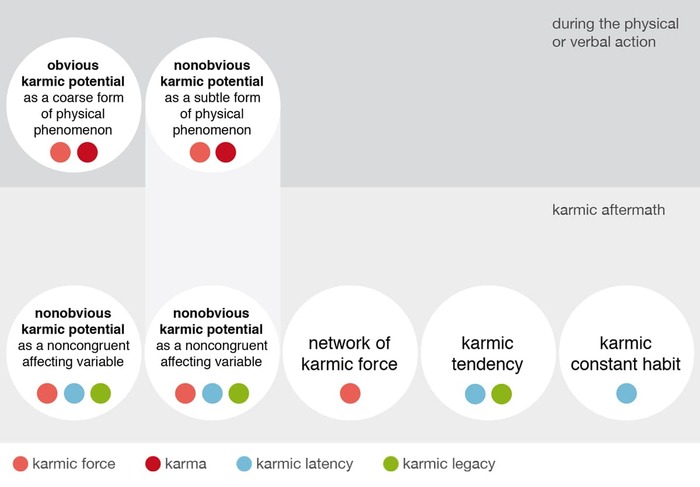
During the first phase of this first aspect of karmic force, the karmic force is a revealing form. Let's call the karmic force during this phase obvious karmic potential as a coarse form of physical phenomenon.
During the second phase, when the physical or verbal action ceases, the obvious karmic potential as a coarse form of physical phenomenon undergoes its phase transition and becomes nonobvious karmic potential as a noncongruent affecting variable.
Karmic Force in Terms of Non-revealing Forms
The second aspect of the karmic force of physical and verbal actions is in regard to the non-revealing forms (rnam-par rig-byed ma-yin-pa’i gzugs) of the actions. Non-revealing forms are somewhat like the dynamic energy of the actions and do not reveal the motivations driving them. They arise with the initiation of the action and continue with the mental continuum even after the physical or verbal action has ceased. It lasts only so long as one does not stop repeating the action, for instance by taking a vow to refrain from committing it.
During the first phase of this second aspect of karmic force, the karmic force is a non-revealing form. Let's call the karmic force during this phase nonobvious karmic potential as a subtle form of physical phenomenon.
During the second phase, when one has stopped repeating the action, for instance with a vow, the nonobvious karmic potential as a subtle form of physical phenomenon undergoes its phase transition and becomes nonobvious karmic potential as a noncongruent affecting variable, as is the case during the second phase of the karmic force in terms of revealing forms.
The Karma and the Karmic Force of Physical and Verbal Actions
Sautrantika-Svatantrika and Prasangika accept the Vaibhashika assertion regarding physical and verbal actions, that their obvious karmic potential as a coarse form of physical phenomenon and their nonobvious karmic potential as a subtle form of physical phenomenon both are karmic impulses (karma).
The Karmic Force of Mental Actions
Vaibhashika, Sautrantika-Svatantrika and Prasangika accept the assertions regarding the karmic force of mental actions shared in common by the Sautrantika, Chittamatra and Yogachara-Svatantrika systems. The karmic force of mental actions has two phases:
The first phase of karmic force is as the mental karmic action itself. During this phase, it is obvious karmic potential.
The second phase arises after the mental karmic action of thinking ceases, when the karmic force as a karmic action undergoes a phase transition. It then becomes nonobvious karmic potential.
Both the obvious and nonobvious karmic potentials of mental actions are noncongruent affecting variables.
Mental actions – which function as obvious karmic potentials – are not karmic impulses (karma).