Harappa-Mohenjodaro
The Harappa-Mohenjodaro civilization flourished in the Indus River valley during the third and second millennia BCE. It had commercial contact with the pre-Babylonian Sumerians of the Mesopotamian area in modern-day Iraq, but little cultural influence from them. The people were most likely proto-Dravidians, with a religion having a supreme god who, representing fertility, creation, ascetic yogis with supernatural powers, and the lord of cattle, was somewhat like a prototype of the later Hindu god Shiva. The religious beliefs also included a mother goddess, ritual ablution, phallic worship, and reverence of the sacred peepul (Skt. pippala) tree and of holy animals such as the cow. The peepal is a type of fig tree, known in Buddhism as the bodhi tree.
Starting in the second half of the second millennium BCE, Indo-Iranian tribes invaded and conquered the Indus River valley. Subsequently, they settled there and beyond, to the east, in northern India. These tribes most likely originated in the area of Afghanistan, eastern Iran, and southern West Turkistan, and were known as the “Aryans,” the “noble ones.” The word Iran, in fact, derives from the same source as the word Aryan. Early Iranian and Indian cultures share certain linguistic and religious features in common through these tribes.
With the Aryan invasion, many of the darker-skinned Harappa-Mohenjodaro native people became slaves, while others moved to South India. The class division of the Aryans into nobility and tribesmen was expanded to become the caste system of India. The Sanskrit word for caste, varna, also means color.
The Vedas
In the 13th century BCE., the Aryans established the Paurava Empire in northern India. By the 9th century BCE., their religion was codified in the Vedas.
The Vedic gods are less humanized than their ancient Greek counterparts. They are the maintainers of cosmic order and the upholders of moral good. During its earliest periods, practice of the Vedic religion entailed mostly singing hymns of praise and request to its gods. With the codification of the Vedas, however, society entrusted a caste of priests to make sacrificial offerings into a sacred fire to the gods. The priests were known as “brahmins.” The offerings were required in order to compel the gods to maintain order; otherwise, the gods would not do so. The ceremonial offerings fed into the sacred fire consisted of milk, clarified butter (ghee), grains, and especially “soma,” the intoxicating juice of a possibly psychoactive plant.
The ritual act of making offerings was venerated even more than the gods themselves and, consequently, the brahmin priests played an essential role in society. In other words, society believed that its welfare derived not so much from the favor of the gods, but rather from the brahmins’ correct performance of the offering ritual. Because of this, early Hinduism is usually referred to as “Brahmanism.” Further, society viewed the making of offerings as a debt owed to the gods. This belief gave rise to the Brahmanic concept of positive acts being the performance of one’s duty.
“Mantras” were originally the metric hymns of the Vedas, specifically the Rg Veda, to be sung at the ritual offerings to the gods. Their sound was viewed as having special power, and they were venerated as being unchanging and eternal.
Further, according to the Brahmanic teachings, the universe was created through the sacrifice of Brahma, who was somewhat like a primal giant. In other words, Brahma was the original being out of whom the universe evolved and who then sustains the universe and all life. The parts of his body became different aspects of the universe and the castes of society. Thus, society viewed the universe as an organic whole, mirrored in the human body. After death, human spirits travel through the pathway of the cremation fire to the highest heaven of eternal light. Those who are negative sink into underground darkness.
A large literature evolved from the Vedas. The Brahmanas, in prose, explained the Vedic rituals and aided in their performance. The Puranas gave accounts of history. One epic history in particular, the Mahabharata, became seminal for the development of later, popular Hinduism. It was composed in the 9th century BCE. Also during this period, early ideas developed about another great god, Vishnu.
The Upanishads
The Paurava Empire began to decline in the 8th century BCE., after a great flood caused the relocation of its capital. Slowly, the Empire broke into many smaller states. Some were kingdoms; others were republics. These major changes in Indian society marked the beginning of a period of philosophical and religious speculation.
The final portion of the Brahmanas was the Upanishads, a body of literature that developed, more fully, the philosophical basis for Brahmanism. Written over several hundred years, beginning around the end of the 7th century BCE, twelve of the Upanishads predated Buddha. Although each of the twelve presented slightly different teachings, they shared many general themes.
From the Brahmanic idea of the parallel between human beings and the primal giant, the Upanishads developed the assertion of the identity of atman – the individual self or “soul” – with Brahma. Further, they explained that, as the primary cause of the universe, Brahma periodically created the world out of himself and retracted it back into himself. Depending on the specific Upanishad, this process occurs in one of two ways. Either Brahma evolves into the universe and all the living beings in it; or the universe and all its living beings are merely the appearances of Brahma. In either case, the true reality is the unity of everything and everyone as Brahma. The world of appearances of separate objects and individual beings is illusion (Skt. maya). Individual atmans, or souls, are all, in fact, identical with Brahma.
The Upanishads also introduced the assertions of karma and rebirth. These assertions accord with their explanation that the universe undergoes repeated cycles of creation and destruction over huge spans of time. Similarly, individual souls experience repeated birth and death over countless lifetimes. This cycle of repeated rebirth (Skt. samsara) occurs because of their unawareness of the identity of themselves and Brahma. Moreover, it is driven by the force of their “karma” – their actions based on their unawareness that all is illusion. When one realizes what has always been the case, namely the basic unity between oneself and Brahma, with the separation between the two being a total illusion, one attains liberation (Skt. moksha). The path to liberation involves developing detachment and cultivating a correct understanding of reality through hearing, thinking, and meditating about the unity of the universe. The usual course of human spiritual development, however, passes through four life stages:
- Leading the celibate life of a student (Skt. brahmacharya)
- Becoming a married householder (Skt. grhastha) and raising a family
- Retiring to the forests (Skt. vanaprastha) and living as a hermit
- Renouncing everything (Skt. sannyasa) and, while still living alone in the forests, following intensive spiritual practice for gaining liberation.
Thus, the Upanishads emphasized that the universe is understandable and that to gain liberation from the sufferings of repeated rebirth due to unawareness and karma, one must see the true nature of reality and experience it for oneself. Buddhism and many of the other later Indian philosophical and religious systems accept these premises.
The Political Situation in India during the Time of Shakyamuni Buddha
The division of northern India into republics and kingdoms continued into the time of Shakyamuni Buddha (566–485 BCE). The major ones were the Vrji Republic, with public assemblies and democratic institutions, and the autocratic kingdoms of Kosala and Magadha. Both types of state, however, functioned within the ritual structure of Brahmanism. This is because Brahmanism described the duties of a ruler, rather than his powers and form of government. Buddha was born in Shakya, a former republic incorporated into the Kingdom of Kosala, and taught in both Kosala and Maghadha, as well as in the Vrji Republic.
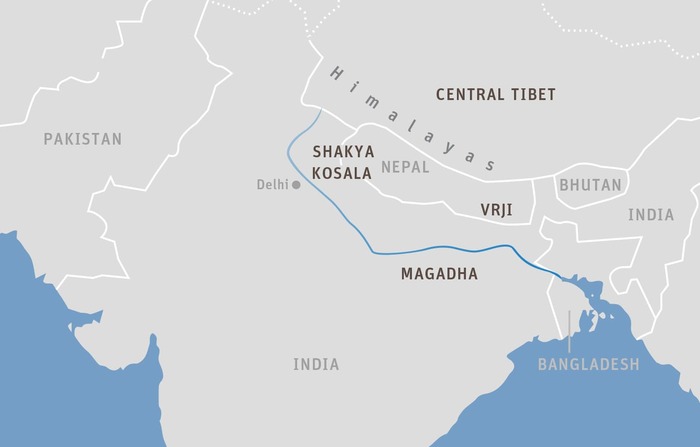
Buddha’s time saw the rise of the merchant class and the accumulation of great fortunes, measured now in money, rather than in cattle. The merchants became wealthier than the kings, and so the kings fought back by taking more autocratic measures to control commerce and society in general. Thus, within the kingdoms, the main preoccupations were gaining economic and political power. Consequently, with their emphasis on money and the use of violent force, the kingdoms became much stronger than the republics – economically, politically, and militarily. As a result, people experienced their freedom becoming increasingly more restricted and their suffering becoming increasingly greater. Many philosophers of the time, including Buddha, sought liberation through spiritual means.
There were two main spiritual groups offering paths to liberation in response to this difficult situation.
- The brahmanas were the orthodoxy, who stayed with the old Brahmanic rituals. They followed the Upanishads as their philosophical basis, but within the context of first leading a life of duty within society and only becoming celibate renunciates after retiring. They were exclusively from the brahmin caste and pursued their path to liberation as solitary ascetics living in the forests.
- The shramanas were wandering mendicant spiritual seekers. They came from castes other than the brahmins and sought liberation by leaving society from the start. They lived together in the forests, with no caste differences, as a spiritual community (Skt. sangha), rather than as solitary ascetics. They organized their autonomous communities on the model of the republics, with decisions made by assemblies. Moreover, all of them rejected a supreme god, such as Brahma, or any other form of a creator. Although the shramana communities had no caste differences within them, the laypeople who followed their teachings to a lesser extent and supported them still lived with the structure of the caste system.
The Five Main Shramana Schools
When Shakyamuni Buddha renounced his princely life, he joined the shramanas. Accordingly, after his enlightenment, he organized the spiritual seekers who followed him into autonomous communities along the same lines as other shramana groups. Thus, Buddhism became the fifth of the five shramana schools of the time.
[See: Life of Shakyamuni Buddha]
The five shramana schools and their basic views were as follows:
- The Ajivika School, founded by Gosala, was deterministic and thus rejected the causal process of karma. They asserted that the constituent elements of the universe – earth, water, fire, wind, happiness, unhappiness, and living souls (Skt. jiva) – are uncreated, partless atoms or monads that do not interact with each other. Because everything is predetermined, although actions do occur through the atoms of these constituents; nevertheless, neither the actions themselves nor the atoms actually cause anything to happen. Living souls pass through an enormous number of rebirths and, after experiencing every possible life, they automatically enter a state of peace and are thus free of rebirth. Liberation, therefore, does not depend on what anyone actually does.
- The Lokayata or Charvaka School, founded by Lokachakshu and taught at the time of the Buddha by Ajita Keshakambala, also rejected karma. Not only that, it also rejected rebirth and any such thing as a living soul. It advocated hedonism, teaching that all actions should be spontaneous and should come from one’s own nature (Skt. svabhava) – in other words, they should be natural. The aim of life was to experience as much sensual pleasure as possible. This school rejected all forms of logic and reasoning as valid ways of knowing anything.
- The Jain or Nirgrantha School, founded by Mahavira, broke away from the Lokayata School as a strong reaction against it. It therefore asserted living souls undergoing rebirth through the force of karma. Jainism, still existent as today as one of the major Indian religious systems, teaches extremely strict ethical behavior and, in fact, extreme asceticism as the means for gaining liberation.
- The Ajnana School of Agnostics, led by Sanjayin, asserted that it was impossible to gain conclusive knowledge about anything through philosophical speculation or debates based on logic. It advocated living in celibate communities that placed their emphasis merely on friendship.
- Buddhism developed as a shramana school that accepted rebirth under the force of karma, while rejecting the existence of the type of soul that other schools asserted. In addition, Buddha accepted as parts of the path to liberation the use of logic and reasoning, as well as ethical behavior, but not to the degree of Jain asceticism. In this way, Buddhism avoided the extremes of the previous four shramana schools.