Parthia and Bactria
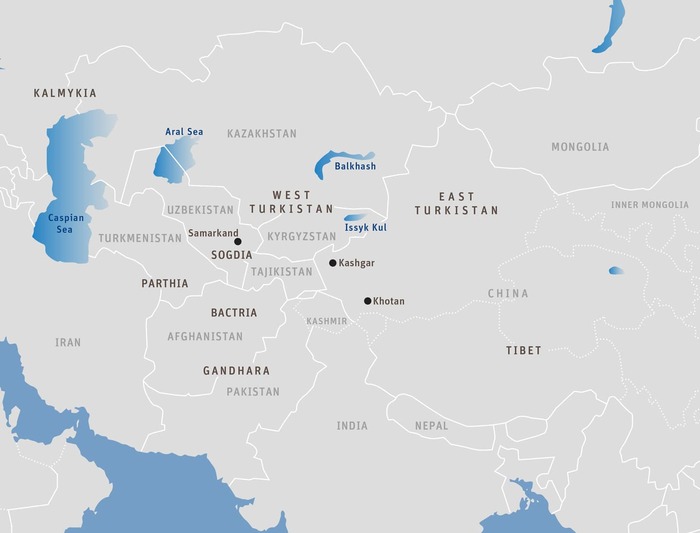
Historically, Buddhism was found in all five former Soviet Central Asian Republics that constitute West Turkistan: Turkmenistan, Uzbekistan, Tajikistan, Kyrgyzstan, and Kazakhstan. It initially spread in the 1st century BCE from Gandhara (Pakistan) and Afghanistan to the kingdoms of Parthia [1] and Bactria. Turkmenistan and northeastern Iran constituted the kingdom of Parthia; while southern Uzbekistan, Tajikistan, and northern Afghanistan constituted the kingdom of Bactria [2].
Sogdia
Buddhism spread to Sogdia [3] in central Uzbekistan and northwestern Tajikistan mostly from Bactria. The 6th century Chinese pilgrim Xuanzang (Hsüan-tsang) reported two huge Buddhist monasteries at the Sogdian capital at Samarkand.
Western Turk Empire
In the 7th century, when the Turkic people from Mongolia conquered most of Central Asia, Buddhism spread from the Sogdians and from Kashgar/Khotan in southern East Turkistan to the Taraz (Talas) River valley in southern Kazakhstan and the Chu River valley in northern Kyrgyzstan. These regions constituted parts of the Western Turk Empire [4]. In the 8th century when Tibet ruled East Turkistan, the Tibetans also occupied eastern Kyrgyzstan, bringing with them early Tibetan Buddhism. [5]
Although Islam came to the southern part of these Central Asian republics in the 9th and 10th centuries, and to the northern part in the eleventh, Buddhism was not totally eliminated in the north. Islam was always weak there and mixed with shamanism and even Buddhism. The main form of Islam throughout the region has always been Sufism, a non-doctrinal sect that emphasizes meditation and a community of highly devoted practitioners living around a master.
The Dzungar Mongols
The Dzungar Mongols [6] of East Turkistan, who followed the Gelug tradition of Tibetan Buddhism and from whom the Kalmyks broke away at the beginning of the 17th century, had tent monasteries in the Semirechye region of eastern Kazakhstan, to the east and south of Lake Balkhash, during the 16th to the mid-18th centuries, and around Lake Issyk Kul in Kyrgyzstan from the mid-17th to the mid-18th century. The Kalmyks also had tent monasteries in many parts of Kazakhstan as they migrated across it to the Volga.
The Dzungars also built stone monasteries [7] in the regions of eastern Kazakhstan surrounding Lake Balkhash. These Gelug monasteries [8] lasted until the mid-19th century, when Kazakhstan was conquered by Russia. It is unclear whether some of these monasteries were built by the Dzungars before their defeat by the Manchus in the mid-18th century and they survived the destruction, or whether they were built by the Dzungar refugees who fled to Kazakhstan after the holocaust and inclusion of East Turkistan into the Manchu Empire of China. Some of them might also have been built by the Kalmyks who returned from the Volga to East Turkistan at the end of the 18th century, but who settled in Kazakhstan. The question is confusing since, in Russian, the Dzungars are commonly referred to also as Kalmyks.
Cultural Borrowing between Buddhism and Islam
Throughout the region, there are many indications of cultural borrowing between Buddhism and Islam. For instance, Kazakh Sufis not only believe in rebirth, but also identify reincarnations of past Sufi masters like the Tibetan and Mongol Buddhists do of their teachers. The Sufis build shrines as graves for their masters, circumambulate them and light butter lamps, reminiscent of Buddhists' practice around stupas of deceased masters. Sufi meditation includes recitation of the Islamic equivalent of mantras, often combined with the breathing cycle, as well as visualization of the Prophet and spiritual masters.
Notes
[1] The remains of two Parthian Buddhist stupas each have been found in Turkmenistan at Mary (Merv) and near Ashkabat. Buddhist caves have also been found near Ashkabat.
[2] The remains of Bactrian Buddhist monasteries have been found near Termez in southern Uzbekistan at Kara Tepe, Fayas Tepe and Dalverzin Tepe, and the remains of a stupa at Zormala and of Buddhist wall murals at Balalyk Tepe, both in the Surkhan Darya region. Remains of a Buddhist monastery have been excavated at Ajina Tepe in southern Tajikistan.
[3] Buddhist remains from the Sogdian culture have been found near Samarkand at Yerkurgan, Uzbekistan, and Panjikent, Tajikistan. They have also been discovered at Kuva in the Ferghana valley of eastern Uzbekistan. The remains at most of the Bactrian sites mentioned above also extend into the Sogdian period.
[4] Findings have been made in the Taraz (Talas) River valley at Sayram Kelye near Shymkent (Chimkent) and at Tektur Mas in Jambyl (Dzhambul) Province. Archeologists are hopeful of finding Buddhist remains also at Kos Tobe near Taraz (Jambyl, Dzhambul). Buddhist sites have been found along the Chu River valley at Kyzyl Uzen near modern Cholpon Ata on the north shore of Lake Issyk Kul, and at Ak-Beshim (Suyab) and Balasaghun near Tokmok (Tokmak) and along the Krasnoya River tributary of the Chu River.
[5] Around Lake Issyk Kul, some "mani" stones have been found underwater near Karakol (Przhevalsk) and along the southern shore at Tamga Gorge, as well as at the Julku and Barskaon Passes to the south and Issykata Pass to the north of the lake.
[6] Mani stones have been found from this period at Tanglaly-Tas in Semirechye, at various sites near Almaty and at Zanka Gorge on the south shore of Lake Issyk Kul.
[7] The remains of stone Dzungar Buddhist monasteries have been found in Kazakhstan at Almalik, along the Ili River to the east of Lake Balkhash near the Kazakh/Chinese border, and at Kyzyl-Kent near Jezkazgan (Dzhezkazgan), along the Sary Su River west of Lake Balkhash. Along the Irtysh River, north of Lake Balkhash near the Kazakh/Russian border, there was a great Buddhist monastery in Semey (Semipalatinsk) and the remains of another have been found at Ablaiket near Ust Kamenogorsk. To the east of Almaty, along the northern face of the Zailisky Ala Tau Mountains that separate Kazakhstan from Lake Issyk Kul, there were Buddhist monasteries all the way to the present Chinese border, with remains at Talgar, near Almaty, and at Sumbe in the Narynkol region on the border.
[8] The latest of them, a wooden monastery, was constructed at Medeu (Medeo) near Almaty in the early 19th century.