What Is Sensitivity?
Certain people seem naturally more sensitive than others. Sometimes this is an admirable quality. Partners are sensitive to each other's moods and do not make demands when the other has had a difficult day. Because of this type of sensitivity, our relations are healthier and our lives are happier. Let us call this ability "balanced sensitivity." In other cases, being sensitive is a disability. Insecure people are sensitive to the point that their feelings are hurt at the slightest remark. This syndrome is known as hypersensitivity. At the other end of the spectrum lies insensitivity. Self-centered persons are insensitive to the effect of their words on others and say whatever comes to their heads.
Sensitivity, then, is a variable that encompasses a wide spectrum. It ranges from insensitivity to hypersensitivity, with balanced sensitivity somewhere between. The degree and quality of our sensitivity, however, are not mathematical constants that remain fixed for a lifetime. Through education and training, we can change them if we wish. To do so, we need to look closely at what sensitivity means. This enables us to differentiate the factors that make it an advantage or a drawback. We can then explore various methods for developing or enhancing the positive variety and for reducing or eliminating the negative ones.
Sensitivity has both physical and mental forms. Physical sensitivity depends on the body's sensory apparatus or immune system. A surgeon, for instance, has sensitive fingers and a person with allergies is sensitive to dust. Here, we shall deal exclusively with the form of sensitivity that is a quality of the mind and heart. Such sensitivity may be to the environment, business, politics, wildlife, other persons, or ourselves. Here, we shall explore the last two forms.
Sensitivity is a function of two variables – attentiveness and responsiveness – each or both of which may be weak, out of proportion, or balanced. With attentiveness, we note the condition of someone, the consequences of our behavior toward him or her, or both. Responsiveness allows a spontaneous or considered reply to what we notice. We do not merely react physically or chemically to what happens around us or to us, like litmus paper reacting to acid. We respond with an emotion, a thought, words, actions, or some combination of the four.
A further dimension of balanced sensitivity is striking a balance between being sensitive to what others require, request, or demand of us, and being sensitive to our own needs. If we constantly cater to others without setting limits, we may strain our physical and emotional resources. Such a syndrome, particularly when accompanied with low self-esteem or a martyr complex, is unhealthy for everyone involved. Similarly, if we only consider our own point of view in interpersonal relations, our narcissistic attitude may alienate us from others.
No one is totally insensitive or hypersensitive; no one caters exclusively to themselves or to others. Our behavior varies according to the situation, the people, and our mood. Moreover, imbalanced sensitivity frequently encompasses both poles of the problem. An overemotional response to someone is often insensitive to the effect that such behavior might have on the person. An impassive lack of attention or response may mask a hypersensitive fear of inadequacy or rejection. When we are hypersensitive to the needs of others, we may easily lose sight of what we require. When we pay excessive attention to our feelings or wishes, we may be insensitive to what others might feel or prefer. Developing balanced sensitivity requires a multidirectional approach.
Exercise 1: Identifying Sensitivity Imbalances
The eighth century Indian Buddhist master Shantideva explained that unless we can see a target clearly, we cannot shoot an arrow into its bull's-eye. Similarly, unless we can recognize the specific types of imbalanced sensitivity from which we suffer, we cannot effectively treat them. Therefore, the first step in our program is to consider various forms of hypersensitivity and insensitivity and then to check if we ever experience them. As both are multifaceted problems, we shall unfold their varieties by focusing on two main variables: attentiveness and responsiveness. Although the analysis is not exhaustive, it includes the more common forms of sensitivity imbalances.
The introspective process requested here is not for the sake of making self-judgments. No moral stigma accrues from being "sensitivity challenged" in certain areas. The purpose of the first exercise is merely to survey our personality, similar to surveying our consumer preferences. Mindfulness of our habits and tendencies provides a clearer idea of the facets of our profile that we need to address.
For practice in a workshop, the group facilitator may choose one example from each category in the schematic outlines. When practicing at home, we may do the same, choosing only personally pertinent examples. For advanced or thorough practice, we may consider all the cited examples.
Forms of Hypersensitivity
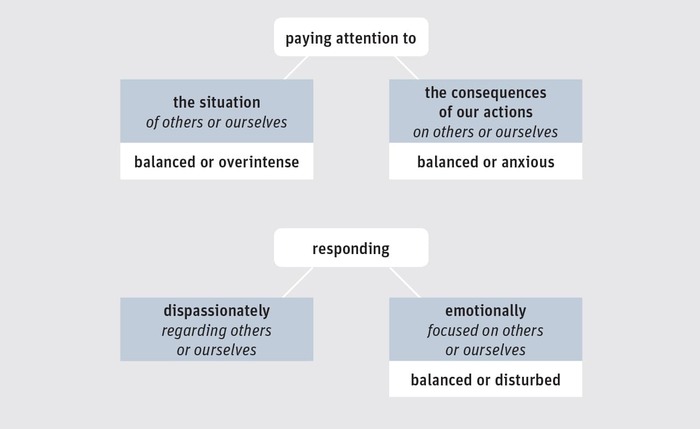
The first scheme presents four sets of alternative forms of behavior regarding others or ourselves. The alternatives are either a balanced way of acting or a hypersensitive one. Pausing after each pair of alternatives, we need to consider which of the cited examples is more typical of us. If neither example fits our pattern, we may try to find illustrations that are more relevant to our personal life.
- We may pay attention to a situation in either a balanced or an overintense manner. Regarding others, we may ask our sick child, for example, how he or she feels or we might pester our child with this question every five minutes. Concerning ourselves, we may watch our health or be a hypochondriac.
- Paying attention to the consequences of our actions may take either a balanced or an anxious form. Regarding others, we may consider their opinion when deciding something or we might be so frightened of disapproval that it disables us from doing what is best. Concerning ourselves, we may take care to do well at school or we might worry obsessively about failure.
- We respond to what we notice in two ways – either dispassionately or overemotionally. Regarding others, suppose we notice someone trying to pass us on the highway. We may respond soberly and shift lanes or we might become heated and think obscenities. Concerning ourselves, we may respond calmly to misplacing our keys and search systematically or we might panic.
- Furthermore, an emotional response need not be overemotional. It may be balanced or disturbed. Regarding others, we may notice that our partner is upset and respond with tender compassion. Alternatively, we might become upset ourselves. Focusing on ourselves when we suffer a loss, we may feel sad, but still maintain our dignity, or we may wallow in self-pity and depression.
Balanced and Hypersensitive Alternatives
Manifestations of Insensitivity
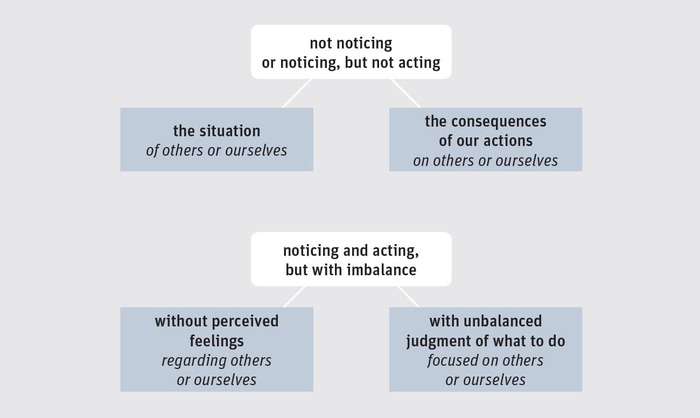
The second scheme presents five common manifestations of insensitivity, each of which may also regard others or ourselves. Continuing our introspection, we need to look for traces of the cited examples or of other illustrations we may find in ourselves.
- We may not notice or pay attention to a situation. Regarding others, we may not notice that a relative is upset. Concerning ourselves, we may not pay attention to the fact that our relationship with our partner is unhealthy.
- Similarly, we may not pay attention to the consequences of our actions. Regarding others, we may not notice that we have hurt someone's feelings. Concerning ourselves, we may not notice that overwork is causing us stress. In these first two forms of insensitivity, our inattention may go beyond not noticing something. We might also deny its existence.
- Even if we notice and acknowledge either a situation or the consequences of our actions, we may still not do anything about it. Regarding others, we may notice an injured person lying alone in the street, but not stop to offer help. Regarding ourselves, we may notice that we feel tired while doing work that can wait. Yet, we ignore our feelings and do not stop working.
- Even when we notice something in others or ourselves and act in response, we may not have any perceived feelings. Concerning others, we may attentively care for a sick person, but without any feelings at all, like a nurse attending a patient in a cold, businesslike manner, simply as a job. When this happens, we may become insensitive both to the person and to ourselves. Concerning ourselves, we may follow a special regime when sick, but, unable to relate to our body or our illness, we may emotionally distance ourselves. Not feeling anything, however, is different from being dispassionate and calm. Calmness is a state of balance, not an absence of feelings.
- Suppose we notice something in others or ourselves, act in response, and feel something while acting. Still, our decision of what to do may be insensitive because our judgment is unbalanced. Regarding others, we may give them what we want, such as economic security, rather than what they need, such as more understanding and affection. Regarding ourselves, we may do what others want us to do, such as spend a great deal of time with them, rather than what we need to do, namely take more time for ourselves.
Forms of Insensitivity
Outline of Exercise 1: Identifying Sensitivity Imbalances
Procedure
In the case of balanced sensitivity versus hypersensitivity, pause after each pair of alternatives and consider which of the cited examples is more typical of you
In the case of forms of insensitivity, look for traces of each example from your life
- For practice in a workshop, choose one example from each category
- When practicing at home, choose only personally relevant examples
- For advanced or thorough practice, consider all the cited examples
Examples
1. Balanced sensitivity versus hypersensitivity
Paying attention to a situation
- Asking your sick child how he or she feels – or pestering the child with this question every five minutes
- Watching your health – or being a hypochondriac
Paying attention to the consequences of your actions
- Considering others' opinion when deciding something – or being so frightened of disapproval that it disables you
- Taking care to do well at school – or worrying obsessively about failure
Responding in general
- Soberly shifting lanes when someone tries to pass you – or becoming heated and thinking obscenities
- Calmly searching for your misplaced keys – or panicking
Responding emotionally
- Feeling tender compassion when a loved one is upset – or becoming upset yourself
- Feeling sad, but maintaining your dignity, when suffering a loss – or wallowing in self-pity and depression
2. Forms of insensitivity
Not noticing a situation
- Not noticing that a relative is upset
- Not paying attention to the fact that your relationship with your partner is unhealthy
Not noticing the consequences of your actions
- Not noticing that you have hurt someone's feelings
- Not noticing that overwork is causing you stress
Noticing, but not acting
- Seeing an injured person lying alone in the street, but not stopping to help
- Noticing fatigue while doing work that can wait, but not taking a break
Noticing and acting, but without feelings
- Attentively caring for a sick person, but feeling nothing
- Following a special regime while sick, but, unable to relate to your body or your illness, emotionally distancing yourself
Noticing and acting, but with unbalanced judgment of what to do
- Giving others what you want, such as economic security, rather than what they need, such as more understanding and affection
- Doing what others want you to do, such as spend a great deal of time with them, rather than what you need to do, namely take more time for yourself